Can You Eat Raw Sea Moss? Safety, Iodine and Prep

Short answer
You can eat raw sea moss, and people have long eaten it as food, but it is not risk-free. Sea moss is a source of iodine, which matters for thyroid health, and amounts vary by product. Anyone with a thyroid condition should ask a clinician first.
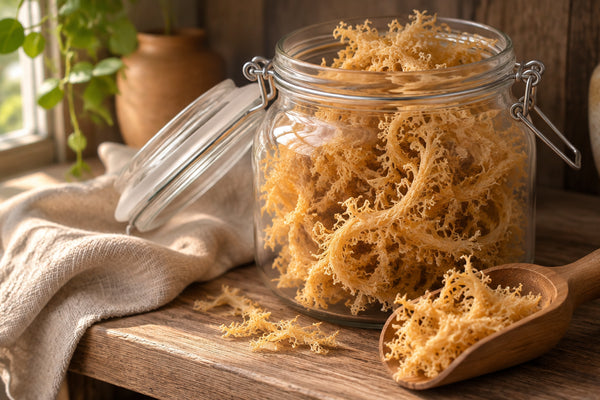
"Raw" can mean freshly harvested moss or the dried whole leaf sold as "raw sea moss". This article covers the dried form, since that is what most shoppers buy.
Who should be careful with raw sea moss and iodine?
Your body needs iodine to make thyroid hormone, but too much can backfire.
A review of excess iodine and thyroid function notes that most healthy people tolerate high intakes. In some, they may trigger an overactive or underactive thyroid, an enlarged thyroid (goiter) or thyroid autoimmunity.
People with existing thyroid disease, or who were previously iodine-deficient, may be more susceptible, in some cases at intakes only slightly above physiological needs. The review lists certain seaweeds among the sources (Farebrother et al., 2019).
Ask your clinician before adding sea moss in any form if you have a thyroid condition, take thyroid medication, are pregnant or nursing, or take any prescription. Our post on sea moss and thyroid health covers the thyroid side in more detail.
How much raw sea moss is a safe food amount?
For most healthy adults at small food-sized amounts, the research we found points to a low risk.
One study measured the iodine in 30 samples of red seaweeds, dulse and Irish moss (Chondrus crispus). It concluded that eating 4 g per day did not pose a health risk. Reaching the adult upper limit of 1,100 mcg of iodine per day from Irish moss would take about 286 g per day.
The authors also said consumers should respect the packers' consumption guidelines (Darias-Rosales et al., 2020).
That was one sample set. Iodine content differs between batches, species and harvest areas, so treat it as a reference point, not a promise about any specific product. We found no research-backed daily amount for raw sea moss, so we are not giving one. Start with the label or packer's guideline, and see our sea moss dosage guide for what is and is not known.
Does soaking or boiling sea moss change what is in it?
It can. In a study of four seaweed species, including C. crispus, rehydration and boiling released part of the iodine, total arsenic and selenium into the water. The amount depended on the species.
For some species, high iodine and arsenic levels might still pose risks even after 20 minutes of boiling (Correia et al., 2021).
The study measured seaweed as processed food, not sea moss gel. It gives no rule for how long to soak or boil yours, and we are not offering one.
Do you have to turn dried sea moss into gel?
Nothing we found says you must make a gel, and we found no study comparing dried sea moss eaten as is with the same moss prepared as a gel.
The practical difference is texture. The dried leaf is tough, and gel is the form most people stir into drinks or food. If you want to try it, see how to make sea moss gel and how to use sea moss gel.
What should you check before buying raw sea moss?
- The species. The research above is on Chondrus crispus, so check that the label names the species you expect. Our guide on real vs fake sea moss helps with this.
- Testing. Seaweed can accumulate elements from seawater, and a study of edible seaweeds describes both essential and toxic elements in them (Essential and toxic elements in seaweeds for human consumption, 2016). Ask for third-party test results.
- Label directions. Follow the preparation and serving guidance on the package.
MAJU's Wild Sea Moss is listed as a raw, dried, whole-leaf Chondrus crispus. The product page does not clearly provide iodine per gram or a serving size, so we do not quote either. Check the label on your bottle before you use it.
References
- Darias-Rosales J, et al. Risk assessment of iodine intake from the consumption of red seaweeds (Palmaria palmata and Chondrus crispus). Environ Sci Pollut Res Int. 2020. PubMed 32803579
- Farebrother J, Zimmermann MB, Andersson M. Excess iodine intake: sources, assessment, and effects on thyroid function. Ann N Y Acad Sci. 2019. PubMed 30891786
- Correia H, et al. Seaweeds rehydration and boiling: Impact on iodine, sodium, potassium, selenium, and total arsenic contents and health benefits for consumption. Food Chem Toxicol. 2021. PubMed 34237393
- Essential and toxic elements in seaweeds for human consumption. J Toxicol Environ Health A. 2016. PubMed 26817952
- MAJU Superfoods. Wild Sea Moss, Raw Dried product page.
Written by Jennifer Wright, Content Editor at MAJU Superfoods. Researched and sourced under our editorial standards. Last updated November 2026.
These statements have not been evaluated by the Food and Drug Administration. This product is not intended to diagnose, treat, cure, or prevent any disease.
Ready to try Maju?
Browse our best sellers. Free US shipping on orders $75+.
Shop best sellers